

Announcing Profitmind Awase 0.5: A 2B-Parameter Embedding Model for Product Identity Resolution
Profitmind Awase resolves product identity across retailer catalogs without using UPCs, GTINs or any other universal identifier as input, even on assortments where products carry no usable barcode or carry the wrong one. It leads leading commercial and open embedding models and a frontier VLM re-ranker on both of our benchmarks. The gain comes from training data, not architecture. In production with retail customers since April 2026.
A dedicated model for product matching
At Profitmind we match our retailers' products to their competitors' products, for competitive price analysis and assortment intelligence. Profitmind Awase is a 2B-parameter embedding model built for that task: matching products across retailers that share no universal identifier and whose titles, descriptions and images may have nothing in common.
The common use case for retail embedding models is front-end search. A shopper types "green shirt" and the system returns the green shirts a retailer offers. That is query-to-product retrieval, and it is the wrong objective for us. We do product-to-product search across retailers, each of which represents the same product differently. It is the harder problem, because we are looking for a product's identical twin. Customers search fuzzily. We need exactness. We also have to handle richer inputs on both sides: images, titles, and long descriptions carrying exact specifications and dimensions.
Identifier lookup (UPC, GTIN, EAN) fails often enough to be unusable as a primary method. Products are registered independently by each retailer, so the same item routinely carries different barcodes. Identifier systems do not interoperate cleanly. And whole categories, fashion apparel among them, have no conventional identifier at all. Where identifiers do exist they are sometimes misapplied, which is more dangerous than their absence: a lookup returns a confident match to the wrong product with no signal that anything went wrong. Awase does not use them. It matches on the product itself.
One distinction matters before the results. Where an identical product exists at a competitor, the task is exact identity resolution, and that is what both benchmarks below measure. In categories such as fashion an identical product frequently does not exist at any competitor, and the useful question becomes which product is the closest comparable one. Awase supports both modes, and the Profitmind platform uses both. The accuracy figures reported here cover exact identity only. Comparable-product selection is evaluated separately and is not reported in this document.
Benchmarking Awase
We tested Profitmind Awase for first-try accuracy (hit@1), meaning the top-ranked result is the exact match we were looking for. Production matching is live retail assortment data across multiple categories, 8,721 queries, human-adjudicated labels. UPC ground truth is 50,000 cross-retailer pairs between two national US mass merchant catalogs, evaluated in both directions for 100,000 queries in total, where two listings count as a match if and only if they carry the same UPC. In the second benchmark the identifier establishes labels only; no model, including Awase, receives it as input.
To build both benchmarks we sampled product matches across as many categories as possible: fashion, hardware, outdoors, groceries, pet products and others. Each query retrieves against the full competitor-side catalog rather than a pre-filtered shortlist.
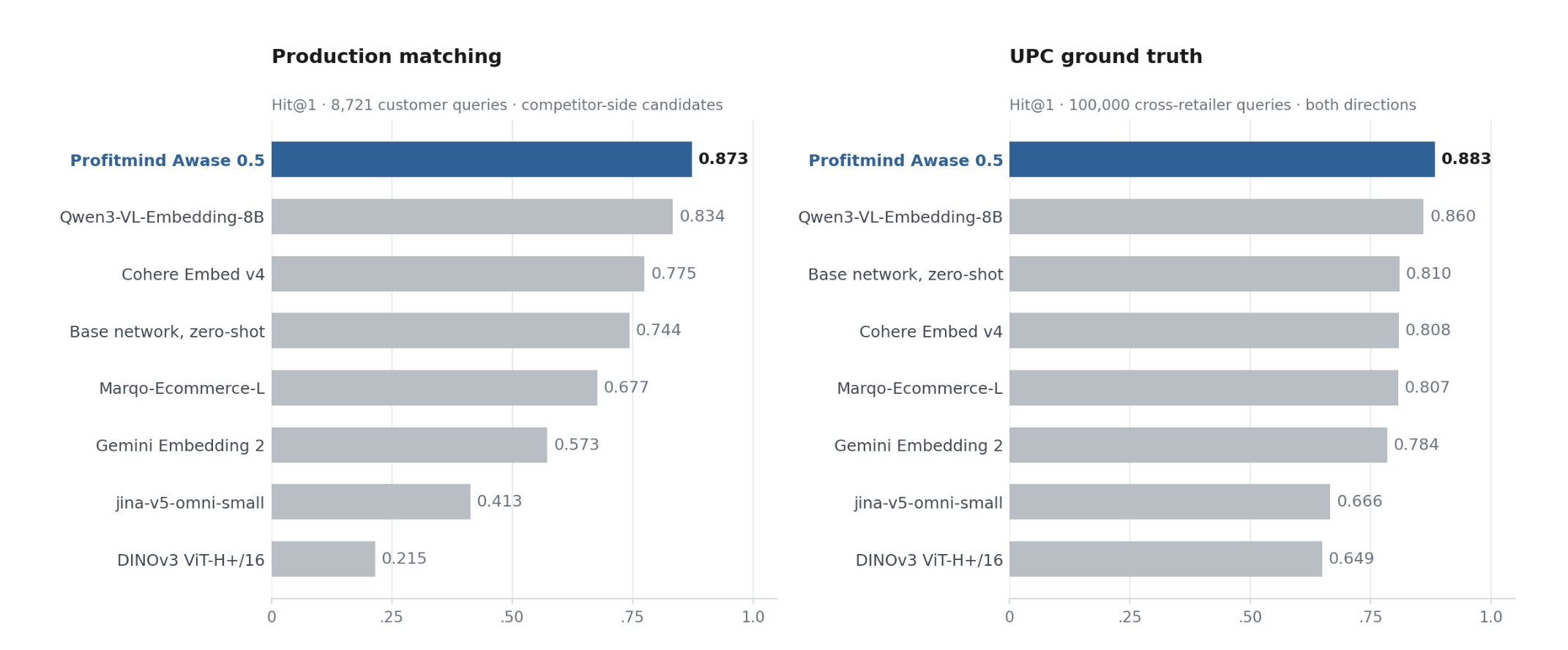

The correct match falls within Awase's top five candidates in approximately 97% of queries on both benchmarks.
In error-reduction terms, Awase produces:
- 50% fewer first-try errors than the same network before training on production matching, halving the error rate, and 38% fewer on ground truth
- 23% fewer than Qwen3-VL-Embedding-8B on production matching, 16% fewer on ground truth
- 28% fewer than the frontier VLM re-ranker on production matching; the two are statistically indistinguishable on ground truth, at roughly four orders of magnitude difference in the inference cost.
- 44% fewer than Cohere Embed v4 and 61% fewer than Marqo-Ecommerce-L on production matching; 39% fewer than each on ground truth
- 78% fewer than jina-v5-omni-small on production matching, 65% fewer on ground truth
One caveat on the ground-truth benchmark, which follows from our own argument above: labels there are raw UPC equality, and misapplied barcodes exist in the wild. Where two listings are the same product but carry different barcodes, a correct match is scored as an error. The reported figure is therefore a floor: true accuracy on that benchmark sits above .883.
How we trained Profitmind Awase
Profitmind Awase is fine-tuned from an open 2B multimodal embedding model. The architecture is public and we make no claim on it. The training data is ours, and that is where the entire gain sits.
The same network, before our training, scores .744 on production matching and .810 on ground truth. After training it reaches .873 and .883, halving the first-try error rate on production matching, with no change to architecture, parameter count, or starting weights. It then out performs a general-purpose model four times its size on both benchmarks. At this scale, on this task, task-specific supervision beat a 4x parameter increase.
The dataset came from two sources. Several years of publicly available retail catalog data across a wide category range, matched at scale and verified. And match feedback from retail merchandisers spanning hundreds of product categories: their own judgments on which product pairs were true matches and which were not, curated into training labels by Profitmind's competitive intelligence team.
That second source is the part that cannot be scraped. We also mined hard negatives: similar products that are not the same product. A 5-lb bag of dog food and a 10-lb bag are hard to tell apart visually, and it matters enormously that we do not treat them as identical. The same holds for the superseded model year and the private-label lookalike that shares a manufacturer but not a SKU. Knowing which distinctions matter in which category is merchandising knowledge, and we learned it from merchandisers rather than inferring it.
Why the task matters
Matching is infrastructure, not a feature. Cross-retailer product identity is the unsolved primitive underneath a class of retail questions, and because it was unsolved those questions were either manual or unanswerable. Four capabilities sit downstream of it, all available in the Profitmind platform today.
- Competitive price analysis. Once a customer's products are matched to their competitors', we track competitor prices continuously, so a retailer sees in real time how a product is moving for a single competitor and across the market.
- Attribute extraction. Attribute values are extracted from every matched product and unified into a single schema representing the market-wide definition of a product, rather than how any one merchant defines it. This normalizes customer and competitor products to each other.
- Assortment and whitespace analysis. With attributes normalized, analytics run across them to give category-wide views and a retailer's position within the market.
- Master data enrichment. Those normalized attributes write back into a retailer's own PIM, validated against how the industry describes the same products. This addresses the comparison and season-over-season consistency problems that make a retailer's own historical assortment data difficult to rely on.
Each layer improves as matching improves, and the normalized product graph that results is the durable asset. The model is the mechanism.
Evaluation methodology
- Models evaluated: Qwen3-VL-Embedding-8B, Cohere Embed v4, Marqo-Ecommerce-L, Gemini Embedding 2, jina-v5-omni-small, DINOv3 ViT-H+/16, a frontier VLM re-ranker, and a zero-shot ablation of our own base network
- Evaluation harness validated by first reproducing comparison models' published scores to within 0.5 points
- All benchmarks decontaminated against training data
- Ground-truth benchmark labels are objective: same UPC or not, no human adjudication
- Abstentions counted as misses
- A single deployed configuration is reported throughout, with no per-benchmark configuration selection. Among candidates we deploy the one with the flattest response across benchmarks rather than the highest peak: for a system that changes prices, robustness is worth more than a fractional point
Base model identity, training procedure, data construction, label taxonomy, negative mining and hyperparameters are proprietary and not described here.
How we use Awase at Profitmind
Profitmind Awase has been deployed with Profitmind customers since April 2026. Matches are surfaced above a confidence threshold; below it, no match is proposed rather than a low-confidence one being offered. Fewer than 1% of surfaced matches are rejected by merchandisers in production. For retailers using the platform, Profitmind has matched products accounting for as much as 95% of revenue against their competitors.
Next
Expansion from one million labelled pairs to the full available set. A selective re-ranking stage for low-confidence queries, motivated by the observation that the correct match is present in the candidate pool far more often than it ranks first. And the same training approach applied at larger scale, which we have not yet run, since inference economics currently favour the present size. Profitmind Awase is available to subscribers. If you would like to know more, please get in touch through the contact form at profitmind.com.
Profitmind FAQs
See how Profitmind can supercharge your business
Discover More
Announcing Profitmind Awase 0.5: A 2B-Parameter Embedding Model for Product Identity Resolution
We are announcing Awase 0.5, a product matching model that finds the same product across retailer catalogs without relying on UPCs or barcodes. In benchmark testing, it outperformed every model tested, including one four times its size.

Retail AI Report: Stripe Buys OpenRouter for $7B
Stripe pays $7B for OpenRouter to wire AI agents into checkout, Amazon aims Alexa at grocery replenishment, and ChatGPT Ads adds product feed bidding.
Retail AI Report: Free AI Agents and New EU Rules
OpenAI lifts ChatGPT chat limits at a billion users, Meta open-sources a local AI agent, and the EU begins enforcing AI transparency rules. What it all means for retail.