

Meet Profitmind Awase: Our Newest Matching Model
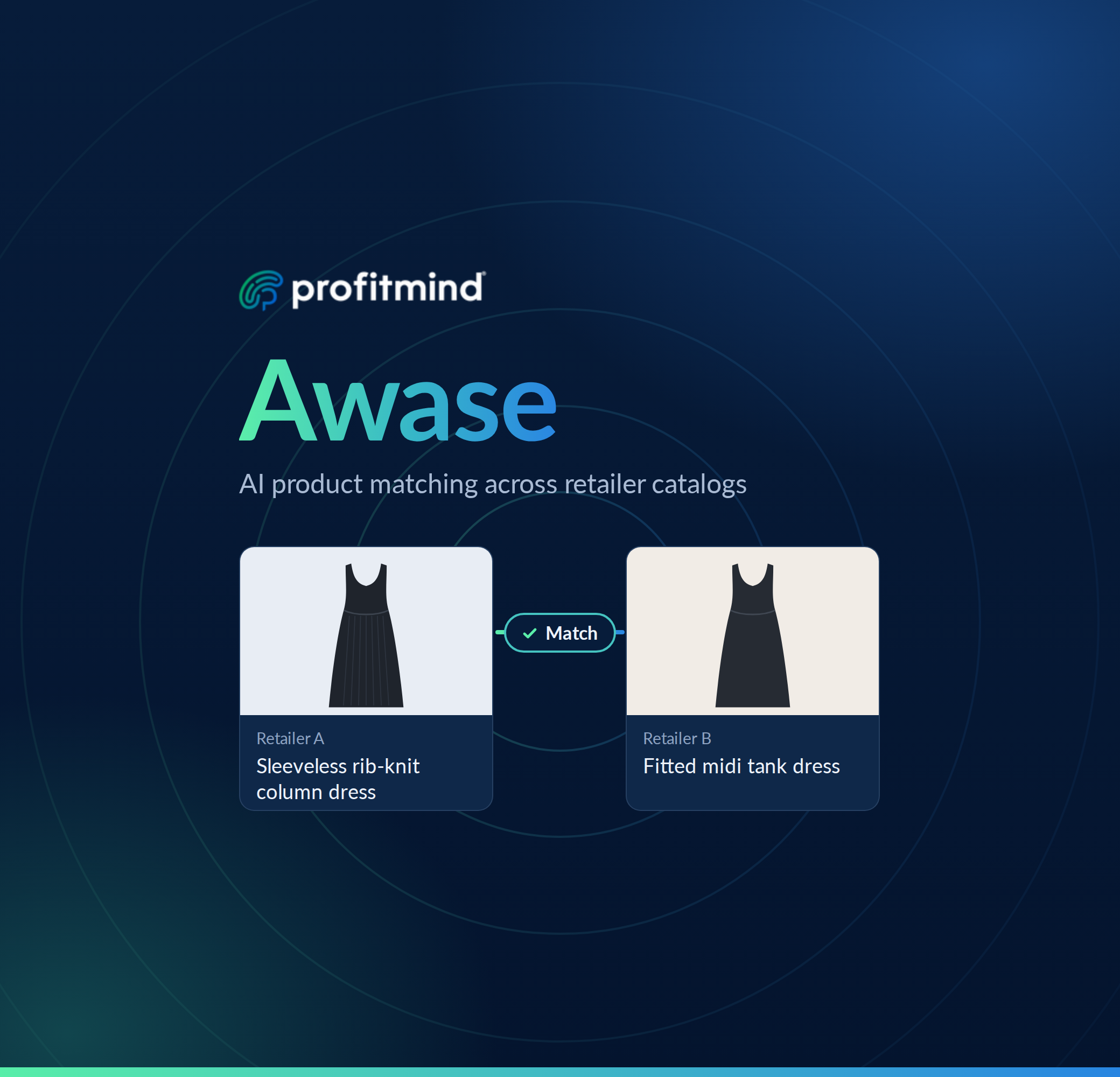
We are excited to introduce Profitmind Awase (pronounced ah-wah-seh), a product-matching model that expands competitive intelligence for retailers by identifying the same product across competing online catalogs without relying on a shared barcode or other product code. In Japanese, "Awase" means to join together, combine, or match, which is exactly what our new product achieves.
Awase analyzes product photography and descriptions together to determine whether two listings represent the same item, including in fashion and other categories where identifiers are unavailable or inconsistent across catalogs. The model has been running in production with Profitmind customers since April 2026. Across that period, fewer than 1% of matches surfaced to retail merchandising teams have been rejected.
“Retailers spend a significant amount of their time trying to understand how they compare to their key competitors,” said Dr. Mark Chrystal, CEO and co-founder of Profitmind. “Merchants often need competitive insights across categories where product identifiers may be missing, inconsistent, or unreliable. Profitmind Awase evaluates the product itself, comparing each product at the detail level of an experienced merchant, so retailers can automate competitive analysis across most of their catalog."
Why product matching is difficult at scale
Competitive analysis depends on a basic question: does a competitor sell the same product, and where no identical product exists, what is the closest comparable one?
In fashion, the answer can be difficult to establish across a large assortment. The same black ribbed midi dress might appear at one retailer as a "sleeveless rib-knit column dress" and at another as a "fitted midi tank dress." At the same time, two products that look nearly identical may differ in fabrication, fit, season, or another detail that matters commercially.
Retail teams have traditionally reconciled those differences through manual competitive shopping, keyword rules, and product identifiers where available. Those approaches don't scale across large, frequently changing assortments, particularly when retailers describe and classify comparable products differently.
Profitmind Awase evaluates a product's image, description, and technical specifications together and identifies the corresponding items in competing catalogs without requiring a shared identifier. That matters most in categories such as fashion, where an identical product often does not exist at a competitor at all. A barcode can only ever confirm an exact match, so it cannot answer the comparable product questions merchants actually ask. Awase identifies exact matches where they exist, and the closest comparable product where they do not. Profitmind Awase was built from a corpus of more than 200 million product listings analyzed over the past five years, across every retail segment and product type.
Performance across live retail assortments
Profitmind tested Awase against eight competing models across 108,721 product comparisons. On 8,721 comparisons drawn from live retail assortments, where usable product identifiers are frequently unavailable, Awase identified the correct competing product on the first attempt 87.3% of the time. On a separate 100,000-query benchmark where matches could be independently verified through shared UPCs, the model achieved 88.3% first-attempt accuracy.
Awase led all other models in both evaluations. Against the strongest retail-specific alternative tested, it produced 61% fewer first-attempt errors.
Turning product identity into market intelligence
Once a retailer can establish which products correspond across competing catalogs, the same matching layer supports a broader set of merchandising decisions. Retailers use Profitmind Awase to compare prices and promotions across more of their assortment, identify whitespace gaps against competing assortments, analyze category trends, and compare marketing activity against like-for-like products.
Profitmind Awase also extracts product attributes from matched listings and reconciles differences in how retailers describe the same item. In fashion, merchants may use different terminology for silhouettes, fabrics, colors, or product features. Awase brings those descriptions into a consistent set of attributes, allowing merchandising teams to compare products and categories using a common market view. Those attributes can also flow back into a retailer's own product information system, creating greater consistency in how products are described across seasons and improving the quality of historical assortment data.
Batteries Plus, a U.S. specialty retailer, began using Awase within Profitmind in April 2026.
“We have used Profitmind’s competitive matching since 2024. With Awase, about 11,000 of our products are now matched to roughly 75,000 competitor listings, up from about 2,000 matches before, giving us visibility into products that account for more than 95% of our consumer revenue,” said Peter Evans, CFO of Batteries Plus. “We use this information to inform when to adjust prices and by how much.”
Built on merchant judgment
Profitmind developed Awase using several years of publicly available retail catalog data along with product-match assessments contributed by retail merchandisers across hundreds of product categories. Those assessments capture how experienced merchants distinguish correct matches from products that appear similar but differ in ways that matter commercially. Profitmind used that expert feedback to build 7 million labeled product pairs, with held-out pairs reserved for evaluation. The current version of Profitmind Awase is trained on 1 million of those pairs, with plans to expand to all 7 million over the next 12 months.
"The hardest matches hinge on subtle attributes that models trained purely on web data miss," said Jeff Rix, Head of AI at Profitmind. "Two styles can look almost identical while differing in fabrication, pack size, model year, or another key attribute that changes the match. Merchants know which details matter. We used that judgment to teach Profitmind Awase how to make those distinctions consistently across large assortments."
Awase is available now to Profitmind subscribers.
Full benchmark results and methodology are published at https://www.profitmind.com/resources/awase.
Read the press releases at the links below:
Profitmind FAQs
See how Profitmind can supercharge your business
Discover More
Meet Profitmind Awase: Our Newest Matching Model
Profitmind introduces Awase, an AI product-matching model that helps retailers find the same or closest comparable product in competitors’ catalogs, even when there’s no barcode to match. It’s already in use with Profitmind customers.
Announcing Profitmind Awase 0.5: A 2B-Parameter Embedding Model for Product Identity Resolution
We are announcing Awase 0.5, a product matching model that finds the same product across retailer catalogs without relying on UPCs or barcodes. In benchmark testing, it outperformed every model tested, including one four times its size.

Retail AI Report: Stripe Buys OpenRouter for $7B
Stripe pays $7B for OpenRouter to wire AI agents into checkout, Amazon aims Alexa at grocery replenishment, and ChatGPT Ads adds product feed bidding.